
App localization is more than translation
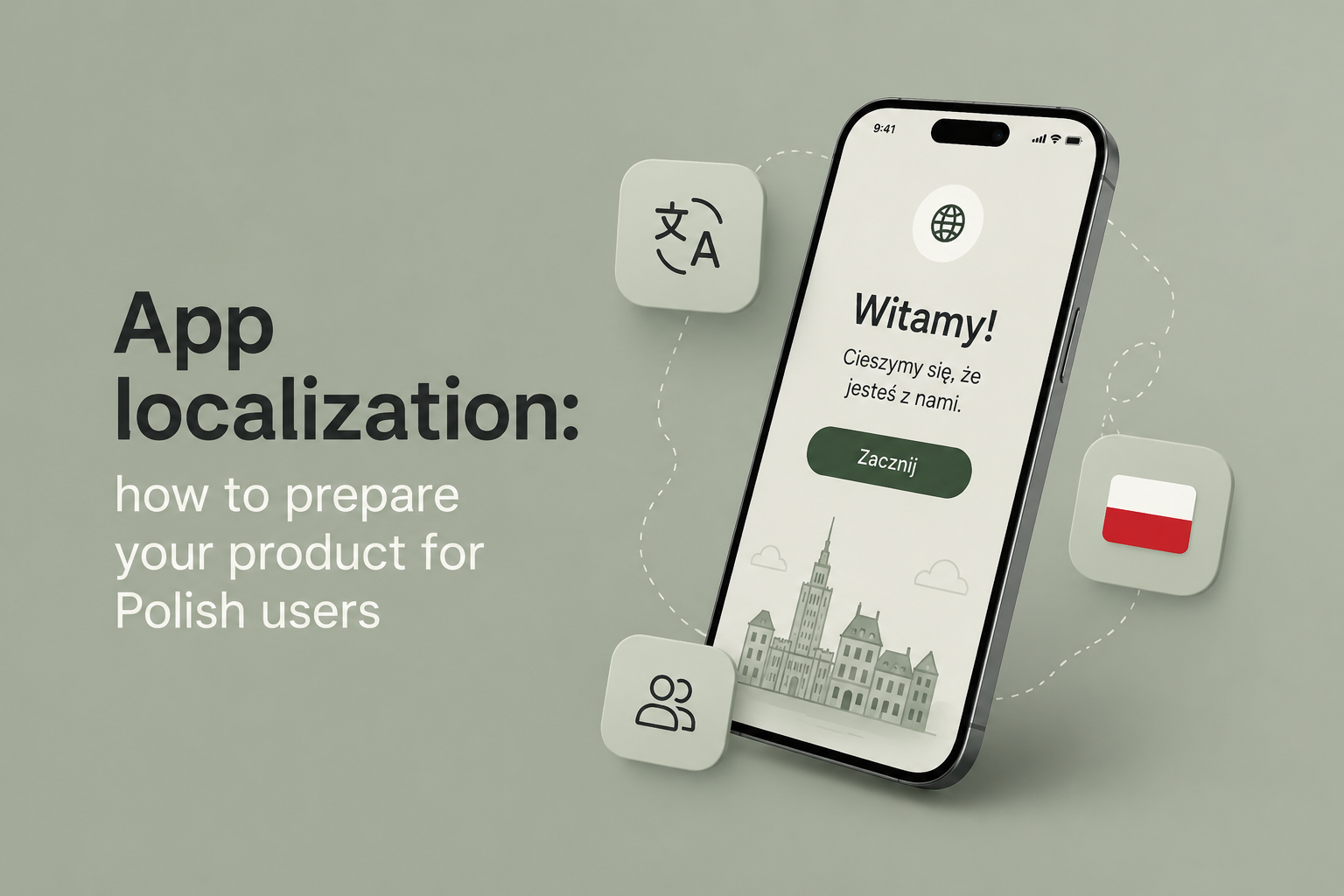
Expanding an app into a new market takes more than translating a list of interface strings. App localization for Polish users requires attention to language, design, user experience, and cultural expectations. Therefore, companies should treat localization as part of the product experience rather than as a final translation task.
Users interact with your app at many stages. They read the app store description before downloading it. Then, they follow onboarding instructions, click buttons, receive notifications, and look for help when something goes wrong. Each of these moments can influence how they perceive your product.
For this reason, inconsistent or unnatural Polish can quickly reduce trust. Even a technically correct translation may feel confusing if it does not fit the interface or user journey. In addition, poorly localized content can make an app harder to navigate.
Working with an experienced language service provider can simplify this process. An LSP can coordinate translation, terminology, linguistic review, and testing. As a result, your team can focus on product development while localization specialists prepare the app for Polish users.
1. What does app localization include?
App localization covers every piece of content that users see throughout their interaction with the product. Therefore, translating the main interface is only one part of the process. A complete localization project should create a consistent Polish experience from the first app store search to everyday use.
First, the localization team translates UI strings such as menus, buttons, settings, and labels. However, these short elements must match the terminology used across the whole application. Onboarding screens also require careful adaptation because they introduce users to key features and guide their first actions.
In addition, localization includes push notifications, pop-up messages, system alerts, and other in-app communication. Help pages, FAQs, tutorials, and support content should follow the same terminology. This consistency makes it easier for users to find information and understand instructions.
App store content is equally important. Titles, descriptions, keywords, screenshots, and promotional text affect both user decisions and app visibility. Consequently, companies benefit from managing all these elements as one localization project. An LSP can coordinate them centrally, which helps maintain quality and reduces the workload for internal teams.
2. Why short interface text can be difficult to translate
Short text may look simple, but it is often one of the most challenging parts of app localization. A button may contain only one word. However, the translator still needs to know what happens when the user clicks it.
For example, English interface words such as “Save,” “Open,” or “Back” can have different Polish translations depending on the context. Therefore, translating isolated strings without seeing the screen can lead to awkward or incorrect choices. Polish grammar can add another layer of complexity because the correct form may depend on gender, grammatical case, or the action described.
Context is especially important for buttons, labels, and error messages. A translator should know where the text appears, what the user is doing, and what follows next. Screenshots, developer comments, character limits, and access to test versions of the app can all help.
For this reason, companies should avoid sending translators a spreadsheet of disconnected strings whenever possible. Instead, an LSP can organize the content, collect context from developers, and manage translator queries. As a result, the final Polish interface becomes clearer, more consistent, and easier to use.
3. Why Polish text expansion can affect layout
Polish translations are often longer than the original English text. Therefore, even a well-translated interface can create layout problems if the design does not allow enough space.
Buttons are a common example. A short English label may fit easily, while the Polish version needs several more characters. As a result, text may become cramped, cut off, or difficult to read. The same issue can affect menus, navigation tabs, headings, pop-up messages, and onboarding screens.
In addition, longer text can change line breaks and screen balance. A message that fits on one line in English may need two or three lines in Polish. Consequently, nearby icons, images, or interface elements may shift or overlap.
For this reason, localization should work closely with UX and development teams. Flexible layouts, responsive components, and realistic character limits can reduce these problems before launch.
An experienced LSP can also flag potential issues during translation and review. This helps teams identify risky strings early. As a result, developers can make small layout adjustments before problems reach users, which saves time and improves the overall localized experience.
4. Why in-app testing matters before release
A translation can look correct in a spreadsheet and still fail inside the app. Therefore, in-app testing should be an important part of every localization project.
During testing, reviewers check how the Polish text appears in the real interface. They can identify truncated labels, broken line breaks, inconsistent terminology, or messages that appear in the wrong context. In addition, they can confirm that placeholders, variables, dates, numbers, and dynamic content display correctly.
Testing also helps assess the user journey. For example, an onboarding instruction may be grammatically correct but still feel unclear when users see it next to a specific button or screen. As a result, reviewers can suggest wording that is more natural and easier to follow.
For companies outsourcing localization, an LSP can coordinate this stage with linguists, developers, and project managers. This reduces the need for internal teams to manage multiple review rounds.
Most importantly, in-app testing checks more than language quality. It confirms that the localized app works as a complete product. Consequently, users receive a smoother and more reliable experience from the first launch.
Make localization part of the product experience
Successful app localization combines language, design, context, and testing. Therefore, preparing an app for Polish users should not begin and end with translation.
Companies need to consider the full user journey. This includes app store content, onboarding, interface strings, notifications, help materials, and in-app messages. In addition, they should allow enough space for Polish text and provide translators with clear context.
Working with an LSP can make this process easier to manage. A professional localization partner can coordinate linguists, terminology, quality checks, developer queries, and in-app testing. As a result, internal teams can spend less time managing individual localization tasks and focus more on product development and growth.
Ultimately, users do not judge a localized app by translation quality alone. They judge how easy it is to understand, navigate, and trust. For this reason, a well-localized app should feel natural from the first interaction. When language and UX work together, the product feels as if it was created with Polish users in mind.